This real estate photography shot list covers a typical three bedroom, two bathroom house in 35 to 45 frames: about 8 exterior, 25 to 30 interior and a handful of details. Each room below has its angles and a frame count, in the order a buyer walks the property, which is also the order the listing displays them.
Real estate work is paid by the property, not by the hour, so the money is in how fast you shoot a complete set. Follow the same list every time and a house becomes a 45 minute job instead of a 90 minute one, with no return visit for the room you forgot. Print it, or save it to your phone, and tick it off as you go. If you want the method behind building one for any other kind of session, that is a shot list you will actually use.
How many photos does a listing need?
Scale the list to the property rather than shooting every house the same way:
| Property | Frames delivered | Time on site |
|---|---|---|
| Studio or one bed flat | 15 to 25 | 30 minutes |
| Two or three bed house | 35 to 45 | 45 to 60 minutes |
| Four or five bed house | 45 to 60 | 60 to 90 minutes |
| Luxury or estate | 60 to 100+ | Half a day, plus twilight |
The rule underneath it: two wide frames per main room, one per minor room, and a detail only where there is something worth selling. Shoot more than you deliver, since brackets and a spare angle cost nothing on site and a lot to come back for.
The exterior shot list (6 to 10 frames)
Check which way the front faces before you go in. A north-facing front is in shade all day and can be shot at any point. A west-facing front wants the afternoon, so do the interior first.
- Front elevation, straight on (1), from a low tripod height, verticals dead vertical. This is usually the lead image.
- Three-quarter front from each corner (2), which shows depth.
- Entrance or front door (1), if it has character.
- Driveway, garage or parking (1).
- Rear elevation from the garden (1), wide.
- Garden from the far end back towards the house (1). This is the frame agents ask for most often after delivery.
- Features (1 to 2): pool, patio, outbuilding, view, street scene if it sells the location.
- Twilight exterior (1, optional), about 20 minutes after sunset with every interior light on, when the property justifies it and the client pays for it.
The interior shot list, room by room
Work through the property in the order a buyer would walk it. The default for every room is two wides from opposite corners at around chest height, verticals straight, f/8. The counts below say where to do more or less.
Entrance and living spaces (6 to 9 frames)
- Entrance hall (1), only if it is attractive. A narrow, dark hallway photograph makes the whole house feel small, so skip it.
- Living room (2 to 3): wide from the doorway corner, wide from the opposite corner including the fireplace or main window, and a third if the room is large or L-shaped.
- Dining room or open plan area (2), one showing how it connects to the kitchen.
- Second reception, snug or family room (1).
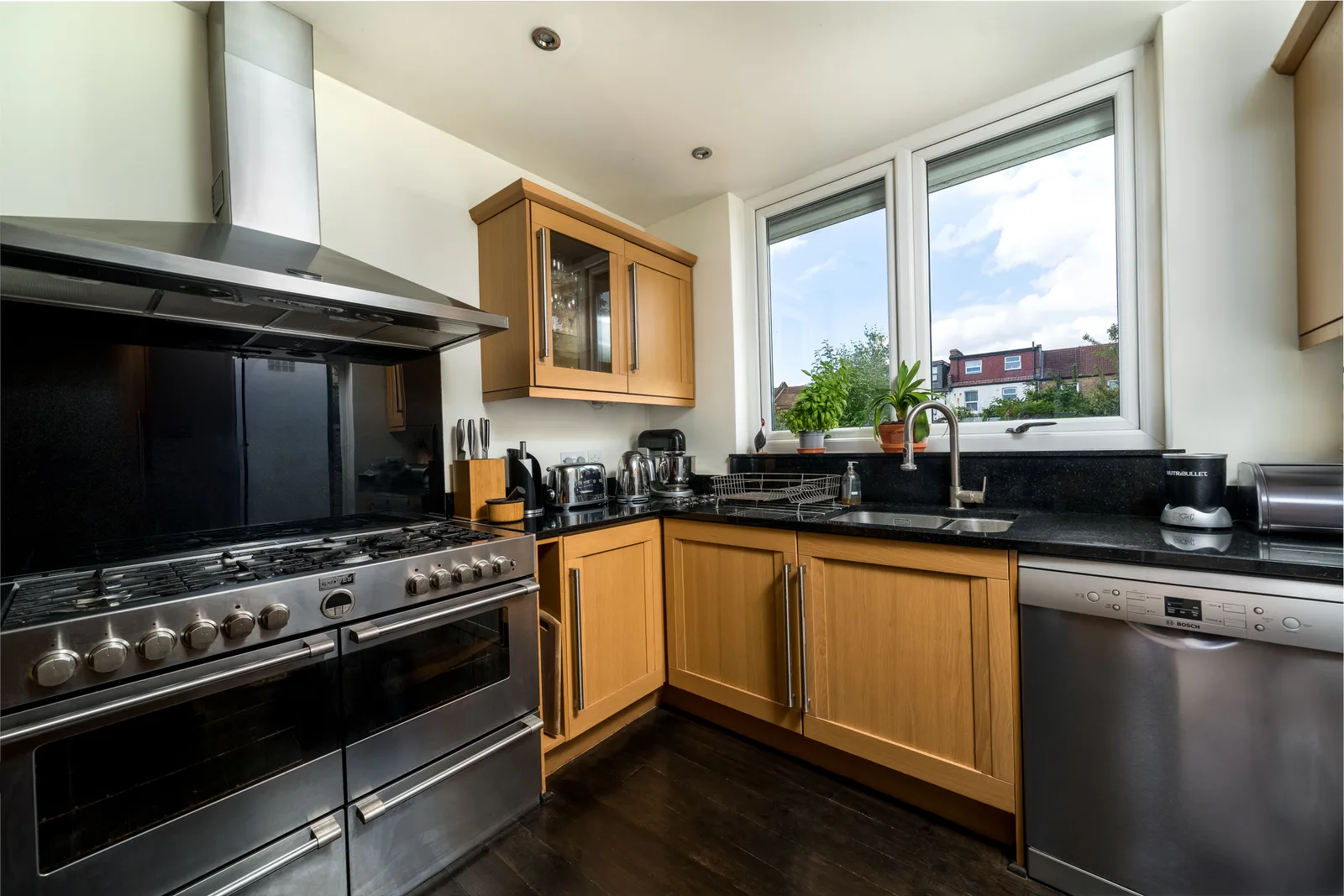
Kitchen (3 to 5 frames)
The most important room in the set, and the one buyers look at longest.
- Wide from the doorway corner (1).
- Wide from the opposite corner (1).
- Island, breakfast bar or dining end (1), if there is one.
- Detail of the range, worktop or a good appliance (1 to 2).
Bedrooms (5 to 8 frames)
- Main bedroom (2 to 3): wide from the doorway corner, wide from the far corner showing the window, and the dressing room or walk-in wardrobe if it has one.
- The view from the main bedroom window (1), if there is one. It sells properties in a way people underestimate.
- Each other bedroom (1 each, 2 for a large one).
Bathrooms (3 to 5 frames)
- Main or ensuite bathroom (2): one wide from the doorway and one detail (freestanding bath, double basin, walk-in shower).
- Family bathroom (1).
- Cloakroom or downstairs WC (1), only if it is finished nicely.
- Check every mirror and glass screen for your own reflection before you move on.
Supporting spaces (2 to 6 frames)
- Stairs and landing (1), if they are a feature.
- Home office or study (1).
- Utility, laundry or boot room (1).
- Garage, loft conversion, basement, cellar (1 each).
- Conservatory or garden room (1 to 2).
Details (2 to 4 frames)
- Fireplace, original features, built-in storage, smart heating, a wine fridge. Pick what the agent will write about in the listing text, and ask them if you are not sure.
The prep list to send the agent
Send this 48 hours ahead. Everything on it is time you will otherwise spend on site, tidying someone's kitchen.
- All lights on, every bulb working and matching in colour where possible.
- Blinds and curtains open, unless the view is bad.
- Cars off the driveway, bins out of sight, lawn mown.
- Kitchen and bathroom counters cleared: no bottles, dish racks, soap dispensers or towels except neat ones.
- Toilet seats down, bathmats straight.
- Personal photographs, fridge magnets and post removed.
- Beds made, cushions square, no laundry.
- Toys and pet bowls put away.
Agents who receive this list get better photographs and a faster sale, and they notice which photographer sent it.
Camera settings for every frame
- Tripod at chest height, around 1.4 m, level. Eye level makes ceilings dominate; too low makes floors dominate.
- Verticals straight. This is the single thing that separates professional from amateur real estate work. Use the camera's level, and correct in editing.
- f/8, ISO 100, and a shutter speed that lets the ambient light do the work.
- 16 to 35mm on full frame, and resist going wider than 16mm. Ultra-wide makes rooms look distorted and buyers feel misled when they visit.
- Bracket three to five frames and blend them, so the view through the window stays visible. Flash-and-ambient blending gives cleaner colour, at the cost of more time on site.
A three-way or geared head makes the levelling much faster, which matters when you shoot forty rooms a week. For the specific setup, see the best tripod for real estate photography.
Adding video to the shot list
If the agent wants a walkthrough video, shoot it after the stills, with the house already staged and lit. A real estate video shot list follows the same route as the photographs, as short clips of 5 to 10 seconds each:
- Slow push towards the front door, then the door opening.
- One slow pan or slide per main room, same order as the stills.
- A reveal of the kitchen from behind the island or a doorway.
- The garden walked from the house outwards.
- Two or three detail clips: a tap running, a fire lit, light through a window.
The mistakes that cost you a reshoot
- Your reflection in a mirror, a window, an oven door or a kettle.
- Mixed lighting. Tungsten lamps against daylight windows, or warm and cool bulbs in one ceiling. Turn lamps off if you cannot balance them.
- A doorway into a messy room at the edge of the frame.
- Uneven verticals, which will be obvious to everyone including the agent.
- No garden from the far end, the most requested missing frame.
Turnaround is the whole business
Listings are time sensitive and agents work to a deadline. A 24 hour turnaround is the professional standard, and 48 is the outer limit before you start losing work to someone faster.
That is achievable because the editing is templated: a lens profile correction, a vertical straighten, the bracket blend, a white balance fix and a consistent export. Build the preset once and the per-property edit drops to a few minutes.
Deliver web-sized and full-resolution versions in one gallery, named by property address, since agents forward these to portals, print brochures and their own marketing. The rest of the business case for this genre, the repeat work and the steady income, is in the real estate starter guide, and what to charge per property is in real estate photography pricing.
Short lets are the same rooms shot for a different buyer. Airbnb photography wants lamps on, amenities in frame, and a hero image that survives being shrunk to a phone thumbnail.