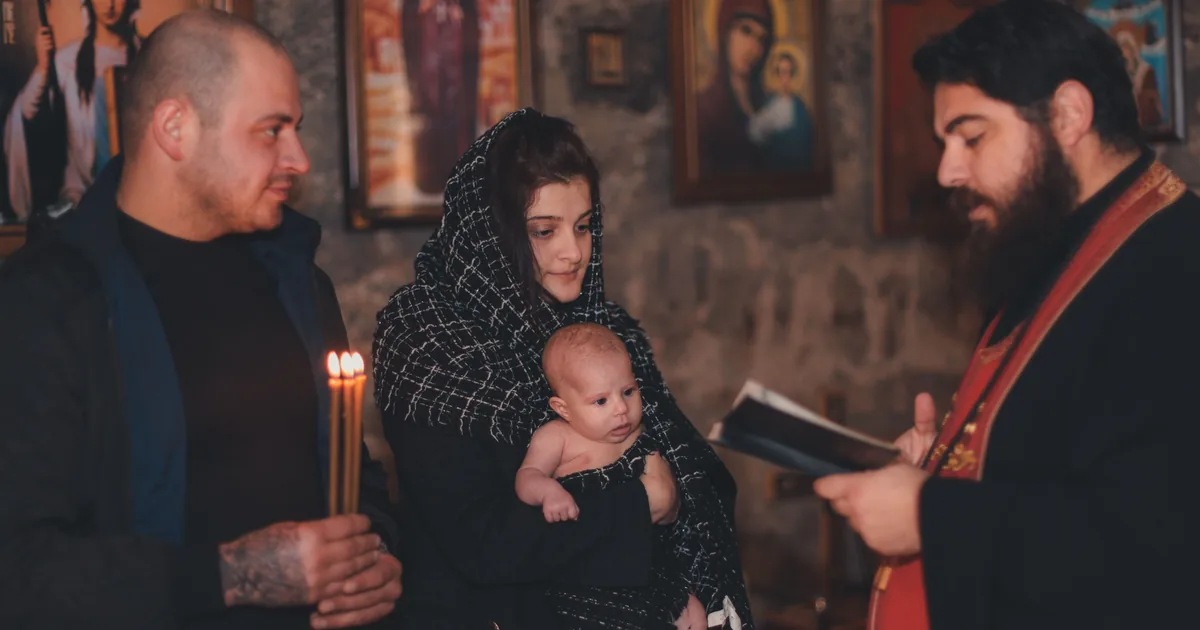
A baptism is short, dark and impossible to repeat. The water is poured in about four seconds, usually by a priest standing exactly where you would like to be, over a baby whose face is turned towards a parent's chest. Most of the work happens before the service: knowing the order of the rite, choosing your spot at the font, and setting the camera so you are not fighting it when the water comes.
The short version: clear the rules with the parish the week before, arrive 30 minutes early, shoot silently without flash at 1/250s or faster with auto ISO, stand where you can see the parents' faces rather than the back of the priest, and get the detail shots and family groups done while everyone is still in the church.
What should you ask the church before a baptism?
Ask the parish office, not the parents, because parents usually assume everything is allowed. You need to know whether flash is allowed (almost never during the rite), whether you may stand at the font or must stay behind the pews, and whether your family shares the service with others. In many Catholic parishes three or four babies are baptised in the same service, and you will get perhaps a minute at the font for yours.
The questions, and the 15 minutes of groups to book afterwards, are covered in detail in how much to charge for baptism photography, because they change the quote as much as the shoot. Add one question that matters for the pictures: which side of the font the priest or vicar stands on, and which way they will face. That decides where you stand.
What camera settings work in a dark church?
Your eyes adjust to a church in a minute; the sensor does not. Expect a dim nave with bright windows behind the font. Set the camera before you go in:
- Shutter: 1/250s. The baby is still, but the hand pouring water is not, and 1/250s freezes the stream. Drop to 1/160s for the quiet moments if you must.
- Aperture: f/2 to f/2.8. Wider than f/2 and you lose the priest's hand or the godparent's face out of the focus plane at a two metre distance.
- ISO: auto, capped at 12,800 on a modern full frame body, or 6,400 on an older crop sensor. A clean f/2.8 at ISO 10,000 beats a blurred frame at ISO 1,600.
- Silent or electronic shutter on. A mechanical shutter at a font is loud enough to turn heads. Check for banding under LED lighting with a test frame first; if bands appear, switch to the camera's quiet mechanical mode if it has one.
- Raw, with white balance set by Kelvin, around 3,800K for tungsten, so the sequence does not shift colour frame to frame as you move between the window and the candles.
- Eye or face detection on, continuous autofocus. Babies turn their heads at exactly the wrong time.
The full sacrifice order for a dim room is in indoor photography without flash.
Which lens should you use for a baptism?
Two primes cover it. A 35mm for the wide frame of the whole family around the font, and an 85mm f/1.8 for the water and faces from two or three metres back. If the parish keeps you behind the pews, a 70 to 200mm f/2.8 is the only lens that will reach the font, and it is worth renting one for the day rather than handing over twenty frames of the backs of heads.
Where should you stand at the font?
Get there 30 minutes early and walk the font with the light. You want to be facing the person holding the baby, across the font from them, so the frame holds the priest's hand, the water and the parent or godparent's face in one line. Standing behind the priest gives you his shoulder; standing beside the parent gives you the side of the baby's head.
If the rite starts at the church door, as the Catholic and Orthodox ones usually do, take one wide frame there and then move to your font position during the readings, when nobody is watching you. Do not move during the pouring itself.
What are the key moments of a baptism, in order?
Knowing the order means you are already in position when each one arrives.
Catholic rite: the welcome at the door and the sign of the cross on the baby's forehead, which parents and godparents repeat; the readings; the anointing on the chest with the oil of catechumens; the blessing of the water; the pouring of water three times; the anointing on the crown of the head with chrism; the white garment; and the candle, lit from the Easter candle and handed to a parent or godparent. The candle hand-off happens in two seconds and is the frame grandparents ask for, so be on the 85mm and ready.
Church of England christening: the sign of the cross, the water at the font, and the lit candle. Many vicars then carry the baby down the aisle to introduce them to the congregation; ask in advance, and be at the end of the aisle with the 35mm when it happens.
Orthodox baptism: longer, often an hour or more, and the best pictures come late. The baby is anointed all over with oil, immersed three times in the font, chrismated, has a few locks of hair cut in the shape of a cross, and is carried three times around the font by the godparent with the candles following. The baby is usually unclothed for the immersion, so ask the parents which frames they want delivered and which they do not.
What should be on the shot list besides the ceremony?
The family groups are the formal list, and they run fastest straight after the service at the font, with a named relative calling people forward. Beyond those, these are the frames families come back for:
- The gown on its own, before the baby is dressed. It is often an heirloom worn by a parent or grandparent.
- The candle, the shell or jug, and the certificate, laid together on a pew in window light.
- The empty font and the church from the back, for the opening frame of the gallery.
- The godparents' hands, either holding the candle or on the baby's shoulder.
- Grandparents holding the baby, one generation at a time, which nobody thinks to ask for until the gallery arrives without it.
For groups bigger than a dozen people, step up on a pew if the church allows it; the advice in how to photograph large groups applies indoors just as well.
How should you deliver baptism photos to the family?
A baptism gallery has two audiences: the parents, who want everything, and the grandparents and godparents, who want two or three pictures to print. Send a sneak peek of the water and the candle within 48 hours, while the family is still sending the group chat around, and the full gallery within two weeks. For a 90 minute ceremony and groups, 80 to 120 finished images is a typical delivery; the photos per session calculator gives you a number for your own coverage.
Keep the gallery private, since it holds images of a baby that the parents may not want public. Delivery is simpler than it sounds: a PIN-protected client gallery with a separate view-only guest PIN lets the parents share the pictures with godparents and grandparents without handing over full control, and favourites come back to you as a print or album shortlist.
Before your next baptism booking, email the parish office with three questions: flash, font access, and which side the priest stands. Their answer tells you which lens to pack.